

7 reasons you might be bloated (+ what to do about it)
your digestion is trying to tell you something

As a nutritionist (and honestly, a human in 2026), one of the most common complaints I hear is bloating. So. Much. Bloating. It feels like everyone is bloated, and whether we like it or not, we’re all being marketed solutions.
There are now entire shelves (and algorithms) dedicated to de-bloat powders, pills, teas, enzymes, drops, and gummies promising immediate relief and a flatter stomach. Some work, some don’t, but none of them help you understand why you’re bloated in the first place.

Okay, so here’s the reframe: bloating isn’t a condition. It’s a symptom. It’s your digestive system giving you feedback.
Everyone experiences bloating from time to time, but as your nutritionist friend, let me be clear: you shouldn’t need a de-bloat product with every meal.
You deserve a digestive system that feels comfortable, predictable, and supportive of your life, so you can do all your things without pain, worry, or digestive stress.
So, with that in mind, here are 7 reasons you might feel bloated, along with actionable solutions.

7 REASONS YOU MIGHT BE BLOATED (+ WHAT TO DO ABOUT IT)
Every one of these points could be a book, so if something here (or multiple things) resonates with you, take it as a sign to dig deeper or contact a nutrition practitioner to help you through it. That’s what we’re here for.
1. STRESS STRESS STRESS
Stress = elevated cortisol, which pushes the body into “fight-or-flight” mode. Blood flow is redirected away from the gut, stomach acid drops, and motility slows, making bloating more likely, especially under chronic stress.
What helps
If bloating worsens during busy or stressful seasons, calming the nervous system is often more impactful than changing foods.
Parasympathetic nervous system activation: The “rest and digest” state of your nervous system can be activated through activities like breathwork (I love box breathing: in for 4, hold for 4, out for 4, hold for 4), gentle movement, time outside, calming music, and (a big one) sleep.
Magnesium: My go to for stress and digestion is magnesium glycinate. Aim for 200-400mg a day.
Adaptogens: Herbs like ashwagandha, rhodiola, holy basil (tulsi), and saffron (a favorite!) can help support cortisol balance over time. A formula I often recommend is Needed’s stress support.
2. EATING TOO FAST OR OVEREATING
We’ve all eaten too quickly or skipped a meal and then eaten too much later on. It happens. But bigger, rushed meals are harder to digest and are a very common cause of bloating.
What helps:
If you feel bloated after large meals (especially in the evening), eating more consistently and intentionally can help.
Don’t skip meals: If snacks or dinner are the times you overdo it, make sure you prioritize breakfast and lunch. Feeling steady and nourished during the day can prevent the kind of hunger that leads to overeating later on.
Chewing (digestion starts in the mouth): Basic, but important. Not only does chewing mechanically break your food down, but it also signals the release of digestive enzymes and stomach acid, preparing your food and your stomach for digestion.
Ginger: Ginger is a powerful botanical that helps move food out of the stomach more efficiently. If you’re out for a meal and feel like you overdid it, try ordering a ginger tea as a night cap or bringing this excellent ginger digestive tea.
A short walk: A 5–10 minute walk after meals can gently stimulate digestion and gut motility.
3. FOOD REACTIONS: SENSITIVITIES & INTOLERANCES
Sometimes there’s a food (or foods) that just doesn’t agree with your body. When foods aren’t well tolerated, they may not be properly digested or can trigger immune activity, both of which can lead to gas, bloating, and discomfort.
What helps:
I like to focus on identifying the trigger food(s), then supporting digestion and gut health. Certain foods may even become tolerable again.
An elimination diet: Still the gold standard for identifying food sensitivities and intolerances. This can be done many ways, but a common starting point is removing the most frequent offenders (often gluten and dairy) for 2–4 weeks, then reintroducing to assess symptoms. This is best done with the guidance of a nutritionist.
Testing: Gut or food sensitivity testing (also with a healthcare provider) can provide helpful clues about what you’re not tolerating. If a sensitivity test flags many foods, that’s often a sign to focus on gut repair rather than long-term avoidance.
Digestive enzymes: If you know you struggle to digest gluten or dairy and are stuck at a pizza restaurant (for example), bring something (like this). For some people this can make a big difference.
L-glutamine: L-glutamine is a great amino acid to know about if you have food sensitivities, as it supports the integrity of the gut lining. As an amino acid, you can get it through animal protein—bone broth and collagen (you know I love my collagen) are also great sources for everyday gut health. Sometimes that’s enough, and sometimes a standalone supplement is needed to reach a more therapeutic dose.
4. CONSTIPATION OR SLOW GUT MOTILITY
Constipation can happen for a lot of reasons (stress, food reactions, dehydration, to name a few) but when things move slowly (or don’t fully empty), pressure and bloating tend to build.
What helps:
This type of bloating often gets worse later in the day and improves after a 💩.
Meet your daily fiber needs: Fiber helps keep things moving. Here are a few posts on fiber if you want to learn how to optimize your intake:


Meal timing: This includes your overnight fast and spacing of meals during the day.
Overnight fast: Many people benefit from a 12–14 hour overnight fast (for example, finishing dinner at 7pm and eating breakfast at 7am).
Spacing of daytime meals: The gut relies on the migrating motor complex (MMC), a broom that sweeps food residue and bacteria through the digestive tract between meals. It takes a few hours to activate, so aim for at least one solid 3–5 hour window between meals every day, and avoid grazing.
Probiotics: Probiotics can be a game changer for regularity. Seed is a go-to for me, and I’ve seen it help countless people with constipation. But before you take a probiotic, make sure you’re also eating fermented foods (like sauerkraut, yogurt, miso) daily. And if probiotics/fermented foods do you in, then see the next point.
Bone broth: Bone broth is a gentle, hydrating, and can act as a mild natural laxative (plus it has that L-Glutamine).
And don’t forget to drink water.
5. SIBO (Small Intestinal Bacterial Overgrowth)
SIBO happens when bacteria that normally belong in the large intestine overgrow in the small intestine, where they ferment food too early in digestion (very uncomfortable). About 40% of people with IBS also have SIBO.
What helps:
First, get tested. Ask your GI doctor for a hydrogen breath test.
Work with a qualified healthcare practitioner: Trying to manage SIBO alone often leads to unnecessary restriction, frustration, and lost time. There are dietary strategies than can help, but I’d recommend working with a practitioner you trust to guide you.
6. HORMONAL SHIFTS
Women get these wonderful hormonal fluctuations every month that come with so many pleasant surprises, including (for some) bloating. Estrogen and progesterone influence both fluid retention and gut motility, which is why many women notice bloating around PMS, ovulation, or other points in their cycle.
What helps:
Many of the aforementioned tips (ginger, bone broth, magnesium, etc) can be effective here, as well as:
Gentle movement and consistent meals: Regular meals and light movement (especially walking) support digestion and help counter hormone-related sluggishness.
Track symptoms alongside your cycle: Noticing when bloating shows up can be surprisingly informative (and reassuring) and can help you adjust food, movement, and expectations during certain phases.
7. TOO MUCH FIBER TOO QUICKLY
I know everyone is obsessed with fiber right now (including me, always!), but when fiber intake jumps too quickly, digestion can struggle to keep up.
What helps:
Increasing your fiber can change your digestion (and your health) for the better, but if you’re far from that 35g/a day goal, make sure to ease into it (+5g every few days until you get there).
Digestive enzymes during transitions: Helpful when increasing fiber intake or if you’re sensitive to plant-heavy meals. Hilma’s fiber + digestive enzymes is great for sensitive stomachs trying to increase fiber intake.
Scale fiber gradually: Increase slowly over days to weeks, not all at once. Consistency matters more than speed.
Occasional bloat supplements: Can be useful during travel, holidays, or high-fiber meals you struggle to digest. This is a support tool, not a crutch. Arrae’s popular boat supplement has a mix of organic botanicals like ginger, lemon balm, peppermint and more.

RESOURCES RECAP
I mentioned a lot of tools here, not because you need all of them, but because different types of bloating benefit from different kinds of support. So here’s a quick resource/recap (with discount codes where I have them):
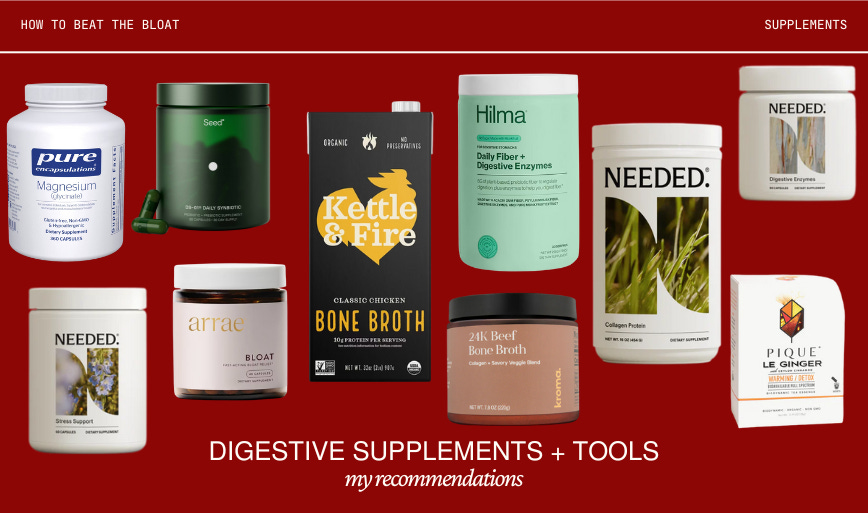
Magnesium glycinate (200-400mg)
Digestive enzymes (discount code: MIA20)
Stress support (discount code: MIA20)
Collagen (discount code: MIA20)
Bone broth (there are many an this is just an example, I also like the convenience of powdered bone broth, just add water—discount code: MIA15)
By the way, shocked how many of these supplements I could find at Target. Love this access!
And if you want more personalized support, I have spaces open for 1:1 nutrition coaching starting in February. Sign up for a chat to learn more.

Thank you, as always, for being here! If you enjoyed this post, please consider tapping the heart button, leaving a comment or sharing with your community.
Your engagement helps me keep this Substack going (and I love to hear from you!).
xx Mia
thanks for all this! really helpful and resourceful!